
ZHI YAN CANDY MACHINERY Co.,Ltd Leading technology Gummy making machinemanufacturers
Contact No.:+86 18221614363
Email:candymachinery@qq.com
Contact No.:+86 18221614363
Email:candymachinery@qq.com
Adr :industrial zone, shanghai
Phone : +86 18221614363
Email : candymachinery@qq.com
Tel : +86 18221614363
How to Choose Exploding Gummy Candies Production Line and Center filling gummy making machine
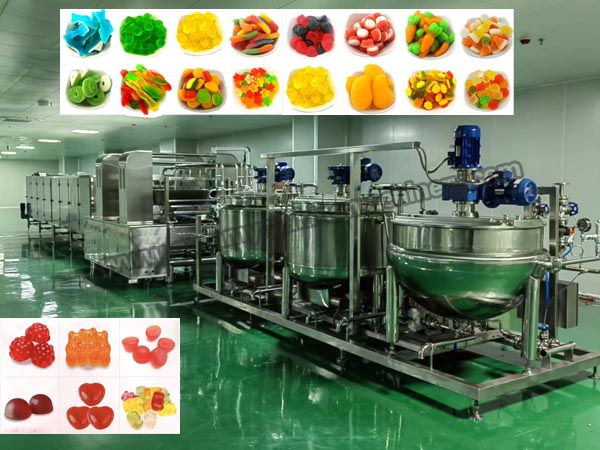
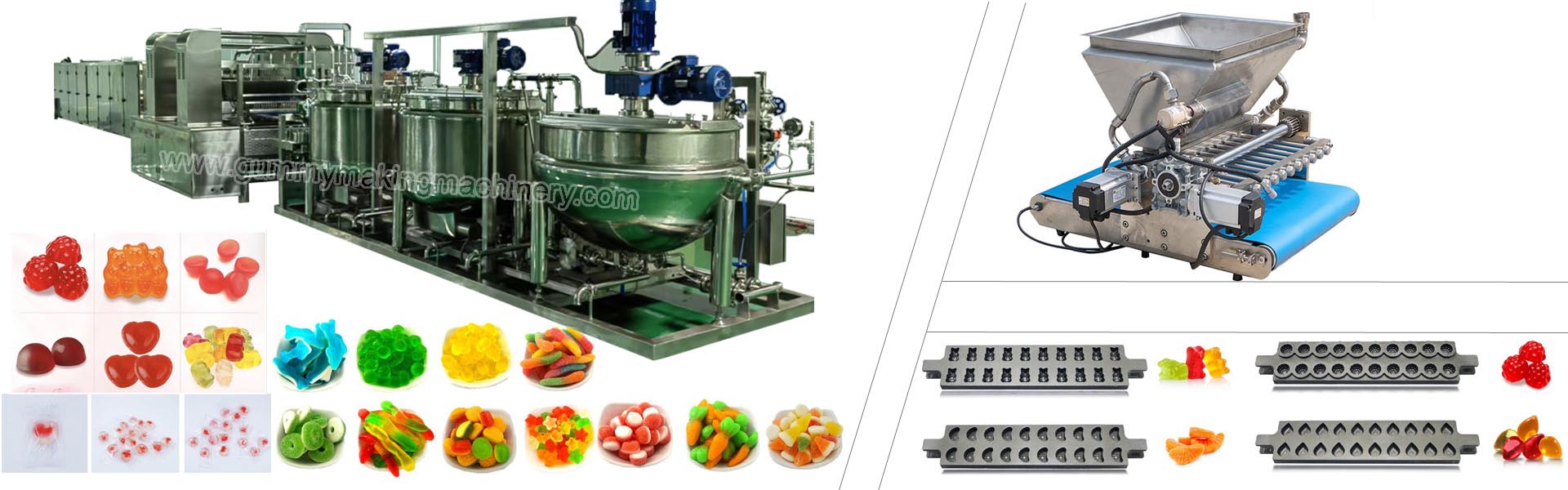
Selecting the right production line equipment for exploding gummy candies requires a comprehensive evaluation of multiple factors, including production capacity, manufacturing processes, and costs. Below are key selection criteria and guidelines:
I. Define Core Requirements and Market Positioning
1. Production Capacity Planning
Small-batch trial production/customization: Choose semi-automatic equipment (e.g., pouring speed of 50–100 molds per minute). Investment costs are low (approximately 100,000–300,000 RMB), making it suitable for R&D or small-order scenarios.
Large-scale production: Requires a fully automatic high-speed line (200–300 molds/minute), with a production capacity of 500–1,000 kg/hour and an equipment investment of 500,000–1,000,000 RMB, suitable for brand mass production.
2. Product Types
Standard burst-filled gummies (e.g., fruit flavors, yogurt fillings): Select a dual-hopper filling machine (supporting simultaneous filling of inner and outer layers), equipped with a temperature control system (to maintain the candy mixture at 60–80°C).
Special shapes (e.g., multi-layer fillings, irregular molds): Equipment must support rapid mold changeovers and feature high-precision filling heads (error ≤ 0.5g) to prevent filling misalignment.
II. Key Considerations for Selecting Core Equipment
1. Filling Machine: The “Heart” of the Production Line
Structural Types
Piston-type filling machine: Suitable for high-viscosity candy paste (e.g., burst-filled candies with high gelatin content). It offers stable pressure and high filling accuracy (single-piece weight error ≤1%), but operates at a slower speed (100–150 molds/minute).
Screw-Type Filling Machine: Suitable for candy pastes with good flowability (e.g., jam fillings). Offers fast filling speed (200–300 molds/minute), but note that screw wear may affect accuracy.
Key Parameters
Number of Filling Heads: Multiple heads (e.g., 12–24) can improve efficiency; selection should be based on the number of mold cavities (e.g., a single mold with 100 cavities requires 10 or more filling heads operating in sync).
Filling Material Synchronization Control: PLC programming is required to control the time difference between the inner and outer layers (accurate to 0.1 seconds) to prevent filling misalignment.
2. Sugar Melting and Boiling Equipment
Double-walled sugar melting kettle: We recommend electric or steam-heated models. The capacity should be determined by production output (e.g., a 1,000-liter kettle is required for a 500 kg/hour capacity). It must be equipped with a stirring device (rotation speed 20–40 rpm) to prevent burning.
Vacuum Boiling Pot: Essential for producing high-transparency bursting-filling candies; it reduces moisture content to below 3%, enhancing the candy’s toughness and preventing filling leakage during bursting.
3. Cooling and Demolding System
Cold Chamber Temperature Control: Must maintain a temperature range of -5°C to 5°C with an airflow velocity of 0.5–1 m/s to ensure rapid setting of the candy paste (cooling time: 10–15 minutes) and prevent deformation during demolding.
Demolding Method: Pneumatic demolding is gentler than mechanical demolding and is suitable for soft candies (especially thin-shelled burst-filled candies), minimizing surface damage.

III. Criteria for Selecting Equipment Suppliers
1. Industry Experience and Case Studies
Preference will be given to manufacturers with over 10 years of experience specializing in candy equipment. Suppliers must provide customer case studies for similar burst-filled candy production lines (e.g., whether they have served well-known gummy candy brands).
Conduct on-site inspections of equipment in operation to assess pouring accuracy, demolding pass rate (which should be ≥95%), and automation levels (e.g., whether one-button mold change is supported).
2. After-Sales and Technical Support
Require suppliers to provide installation and commissioning, operator training (including basic PLC programming), and a warranty of at least one year. It is preferable if they can station an engineer on-site to provide guidance during trial production.
Confirm the lead time for wear-and-tear parts (such as pouring head seals and screws) to ensure it does not exceed 7 days, thereby avoiding the risk of production downtime.
3. Cost and Value for Money
Compare the breakdown of quotes from different suppliers: In a fully automated production line, the injection molding machine accounts for approximately 40% of the total cost (e.g., in a 300,000 RMB system, the injection molding machine costs about 120,000 RMB). Confirm whether molds are included (typically purchased separately, with each mold costing 5,000–10,000 RMB).
Long-term cost considerations: Energy-efficient equipment (e.g., servo motors save 30% more electricity than standard motors) may require an initial investment of 50,000–100,000 RMB more, but the cost can be recouped within 2–3 years through savings on electricity bills.
IV. Recommendations for Other Auxiliary Equipment
Metal detector: Install in the conveying section to prevent impurities from mixing with the candy and ensure compliance with food safety standards.
Drying Equipment: To extend shelf life, consider a tunnel-type drying oven (temperature 40–50°C, humidity ≤30%) to reduce moisture content to below 18%.
Packaging Machine: Select a pillow-type packaging machine (suitable for single-piece packaging) or a vertical packaging machine (suitable for bagging) based on product specifications. The packaging speed must match the production line (e.g., a line with a casting speed of 300 molds/minute requires a packaging speed of ≥300 packs/minute).
V. Tips to Avoid Pitfalls
Avoid low-price traps: Equipment priced 30% below the industry average may suffer from issues such as insufficient precision (e.g., filling weight error >3%) or high failure rates (downtime ≥2 times per month).
Confirm factory conditions in advance: Reserve sufficient floor space for the equipment (approximately 50–80 m² for a fully automated line), and ensure supporting infrastructure such as voltage (380V) and steam piping (if steam heating is used) is in place.
By evaluating the above factors and considering your production capacity, budget, and product positioning, you can select the most cost-effective production line equipment for fudge&gummy candies.
All rights reserved:ZHI YAN CANDY MACHINERY Co.,Ltd SitemapSitemap jelly candy production line Candy making machine candy production line Toffee production line biscuit production line lollipop production line Gummy production line Popping boba production line


